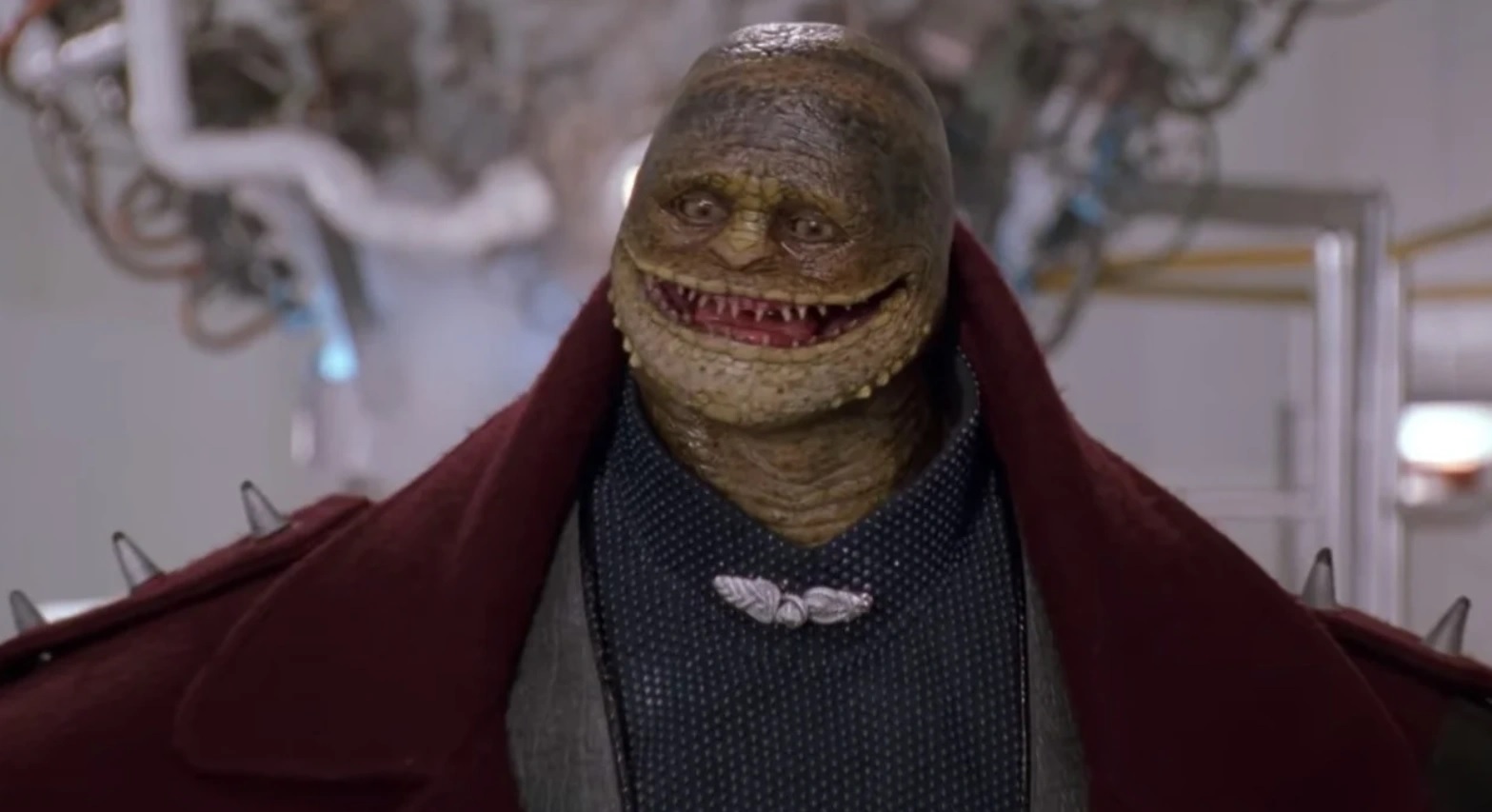
If you close your eyes and think of a Goomba, you probably see a grumpy little brown mushroom with tiny feet. It’s cute. It’s iconic. But for a specific generation of kids who walked into a movie theater in 1993, that image was replaced by something deeply unsettling. I'm talking about the mario live action goomba. It wasn't a mushroom. It wasn't cute. It was a seven-foot-tall, lumbering lizard-man with a tiny, shrunken prosthetic head and a trench coat. It was weird. Honestly, it was a bit of a fever dream that cost millions of dollars to produce.
The 1993 Super Mario Bros. movie is famous for being a production disaster, but nothing encapsulates the "what were they thinking?" energy quite like these creatures. They represent a moment in film history where practical effects were peaking, but the source material was being treated like a suggestion rather than a blueprint.
The Design Logic Behind the Mario Live Action Goomba
Why did they look like that? That's the first thing everyone asks. If you look at the game, there is zero DNA shared between the 8-bit sprite and the creature played by actor Raymond Force. The directors, Rocky Morton and Annabel Jankel, wanted a "realistic" take on a parallel evolution. Basically, the idea was that dinosaurs didn't go extinct; they were pushed into another dimension and evolved into humanoid forms.
In this gritty, cyberpunk version of Dinohattan, a mario live action goomba is actually a de-evolved creature. When King Koopa—played by a very frustrated Dennis Hopper—wanted to punish a citizen, he threw them into a massive de-evolution chamber. The machine would regress their DNA. For loyal soldiers, Koopa kept them mostly humanoid but shrunk their brains (and heads) to make them compliant, muscular henchmen.
It’s a dark concept for a kids' movie. You've got these towering figures with tiny, lizard-like heads that could barely move their mouths. The contrast between the massive, padded suits and the tiny animatronic heads created an uncanny valley effect that still feels gross today. They weren't just enemies; they were tragic, lobotomized citizens.
The Practical Magic of the Suit
Despite how ugly they are, the craftmanship is objectively incredible. These weren't CGI. They were massive foam-latex suits. The actors inside had to look through the neck of the creature because the actual "head" was sitting way above their own.
- Mechanical Heads: The heads were fully animatronic. Cables ran down the back of the suits to puppeteers who controlled the blinking and mouth movements.
- Scale: They stood about seven feet tall. This made Bob Hoskins and John Leguizamo look even smaller, emphasizing the "fish out of water" vibe of the Mario Bros. in this dystopian city.
- The Toad Connection: Most people forget that the street musician Toad—who plays a harmonica and gets arrested—actually becomes a Goomba. That's why one specific Goomba later in the movie plays a harmonica to help Mario and Luigi. It's a weirdly depressing character arc for a Nintendo mascot.
How the 1993 Version Compares to the 2023 Movie
Fast forward thirty years. The 2023 animated Super Mario Bros. Movie from Illumination gave us the Goombas we actually wanted. They were round. They were grumpy. They looked like the games. It was safe.
But there’s something lost in that safety. The mario live action goomba from '93 felt like it had weight and a physical presence. When they marched in those ridiculous red uniforms, you felt the floor shake. The 2023 version is just digital pixels hitting a digital floor. Sure, the 1993 movie was a mess, but the creature design by Patrick Tatopoulos (who later worked on Independence Day and Godzilla) was bold. He took a literal interpretation of "de-evolution" and ran with it until he hit a wall of pure nightmare fuel.
The 1993 film tried to solve a problem that didn't exist: how do you make a mushroom man look scary in a live-action thriller? The answer, apparently, was to make them look like a thumb that grew a face.
The Cult Following and "De-evolution"
Believe it or not, people actually love these things now. There’s a massive community of collectors who hunt for original movie props. Finding an intact mario live action goomba head is like finding the Holy Grail for 90s cinema nerds. The problem is that foam latex rots. Over the last few decades, many of these "tiny heads" have literally crumbled into dust, leaving only the mechanical skeletons behind.
There is a strange nostalgia for the "wrongness" of that era. Before every movie was a perfectly polished corporate product, we had directors who were allowed to make absolute lunacy. If you go to fan conventions today, you’ll see cosplayers in full-sized Goomba suits. They aren't cosplaying the 2023 version. They’re cosplaying the 1993 nightmare. It’s a badge of honor for fans of "bad" cinema.
Why the Design Failed the Audience
We have to be honest: kids hated it. If you were five years old and you loved Super Mario World on the SNES, seeing a lizard in a trench coat call itself a Goomba was confusing. It broke the internal logic of the world.
The movie tried to be Blade Runner for children. It had slime, rust, and weirdly sexualized characters like Lena. The Goombas were the center of that tonal mismatch. They were meant to be comic relief—there’s a famous scene where they dance in an elevator—but their physical appearance was so grotesque that the comedy never really landed for the intended audience.
What You Should Do If You Want to Revisit This Era
If you're looking to dive back into the weird world of the mario live action goomba, don't just watch the movie. It’s a bit of a slog. Instead, look into the behind-the-scenes archives.
- Check out the "Super Mario Bros. The Movie Archive." It is a fan-run site that has saved thousands of production photos, script drafts, and interviews. It’s the best way to see the animatronics without the dim lighting of the film.
- Look for the "Morton-Jankel" cut rumors. There have been long-standing efforts to restore deleted scenes that make the Goombas' origin even darker.
- Watch the "Elevator Scene" on YouTube. It’s the perfect distillation of why this movie is a cult classic. It’s stupid, charming, and technically impressive all at once.
The 1993 Goomba isn't just a failure of adaptation; it's a masterpiece of weird practical effects. It serves as a reminder that sometimes, being "accurate" is less memorable than being absolutely, terrifyingly unique. We’ll never see a major studio take a risk that bizarre ever again. That makes these tiny-headed freaks kind of special.
If you’re a collector or a fan of practical effects, start by researching the work of Patrick Tatopoulos. His sketches for the Mario movie show a much wider range of creatures that never made it to the screen. Understanding the "why" behind the design helps turn a childhood trauma into an appreciation for 90s practical filmmaking. Next time you play the game and stomp on a mushroom, just be glad it doesn't have a tiny face and a leather jacket.