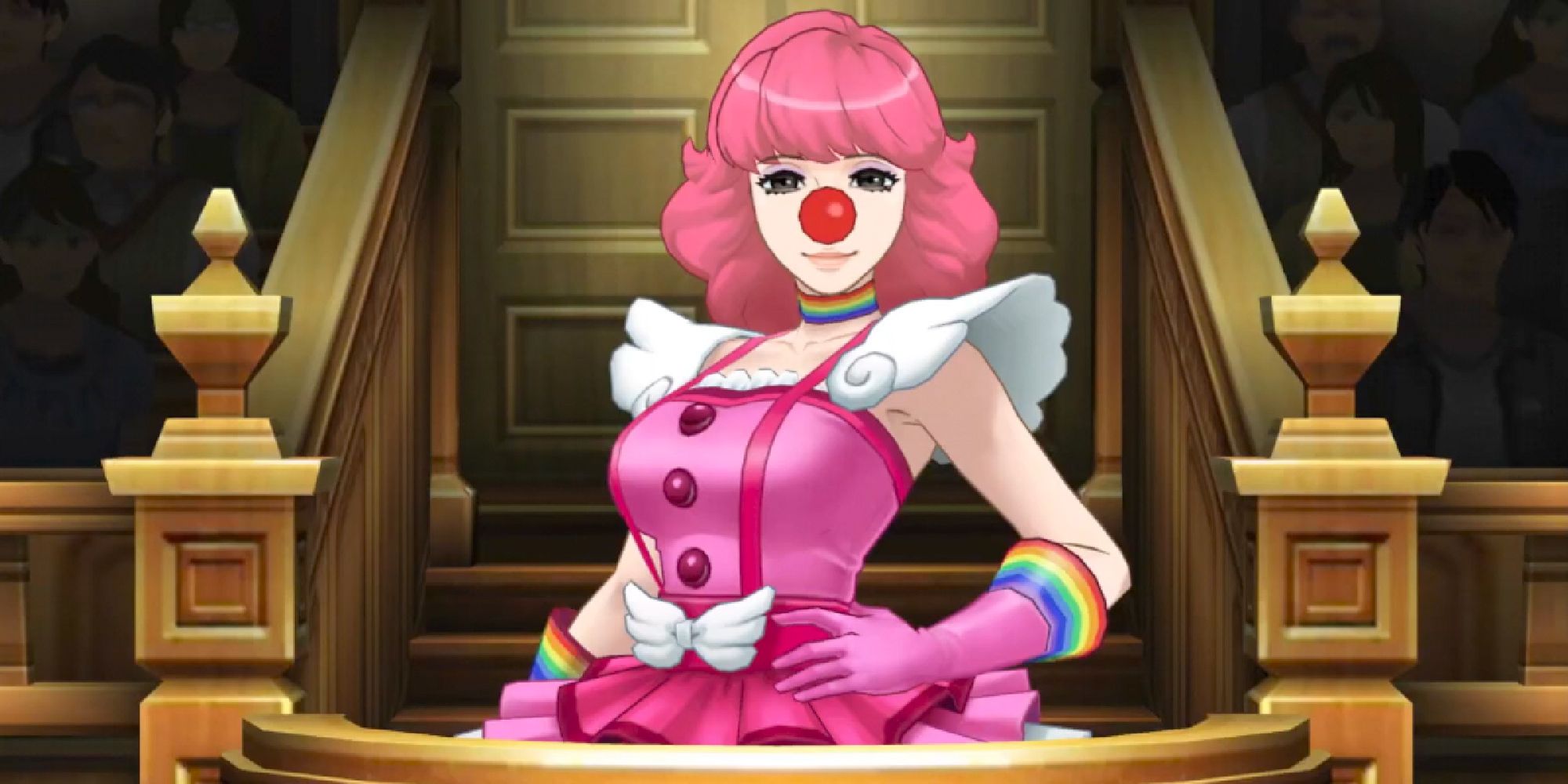
If you’ve spent any time on the "Ace Attorney" side of the internet lately, you’ve probably seen her. Red hair, an oversized coat, and a balloon-sculpting habit that seems physically impossible. I’m talking about Geiru Toneido, the witness from Phoenix Wright: Ace Attorney – Spirit of Justice who launched a thousand memes and single-handedly revived the "clown-girl" aesthetic online. But behind the fan art and the viral videos, there’s a character that actually serves as a masterclass in how Capcom handles tragedy through the lens of the absurd.
She isn't just a gimmick. Geiru is part of a long-standing tradition of the Ace Attorney clown, a trope that dates all the way back to the series' roots with characters like Moe the Clown from Justice for All. However, Geiru is different. She’s polarizing. She’s memorable. And honestly, she might be one of the most tragic figures in the sixth game’s roster, even if people only want to talk about her "balloons."
The Legacy of the Ace Attorney Clown
Capcom loves a circus. We saw it in Berry Big Circus, and we saw it again in the Rakugo theater of Spirit of Justice. The Ace Attorney clown archetype usually follows a specific pattern: they are loud, they are annoying to the protagonist, and they almost always hide a deep-seated insecurity behind their face paint.
Take Lawrence "Moe" Curls. Most players find him grating because his jokes literally drain your health bar if you press him at the wrong time. It’s a bold gameplay mechanic. It makes you hate him, which is exactly how the other characters feel about him. But by the end of that case, you realize he’s the only adult trying to keep a crumbling family of performers together. He’s the heart.
Geiru Toneido follows this path but shifts the focus toward professional jealousy and legacy. She isn’t a circus clown in the traditional sense; she’s a rakugo performer, a storyteller. The clowning is an add-on, a way to modernize her act. But that choice—the decision to be a clown from Ace Attorney rather than a traditionalist—is exactly what fuels the central conflict of "The Magical Turnabout."
What Really Happened in the Toneido Story
Let’s get into the weeds of Case 4 in Spirit of Justice. You aren't playing as Phoenix here; you're Athena Cykes. The stakes feel different. The case involves the death of Taifu Toneido, a master of rakugo. Geiru was his student. She expected to inherit his stage name, Umetoyo.
Instead? He gave it to Umetaro.
That sting is real. Imagine dedicating your life to a craft, changing your entire persona to be more "marketable" as a clown from Ace Attorney, only for your mentor to tell you that you don't have what it takes. Geiru’s breakdown isn’t just about a name. It’s about the fact that she felt she had to betray her father’s style of "true" rakugo just to be noticed, and even then, it wasn't enough.
The complexity of her character is often buried under her design. Yes, the character design by Takuro Fuse is meant to be provocative. It’s meant to distract you. In a courtroom where logic is king, Geiru is a visual loud noise. She’s a walking distraction. When her "balloons" finally pop during her breakdown—revealing they were just air-filled latex and not her actual physique—it’s a literal metaphor for her inflated ego and the facade she built to survive in the entertainment world.
Why the Internet Obsessed Over a 2016 Character in 2022
It's weird, right? Spirit of Justice came out years ago. Why did Geiru suddenly explode?
It started with a fan animation. Specifically, an animation by Speedoru that parodied the character's design. It went viral on Twitter and TikTok, spawning the "Clown-girl" or "Clown-wife" trend. Suddenly, people who had never even touched a Nintendo 3DS were talking about the clown from Ace Attorney.
But there's a downside to that kind of fame. The meme version of Geiru is a hyper-sexualized caricature. The actual character in the game is a murderer driven by a decade of resentment. She killed her master by suffocating him with soba dough. That is dark. It’s quintessential Ace Attorney: taking something mundane—noodles and balloons—and turning it into a grisly crime scene.
Breaking Down the "Moe vs. Geiru" Debate
Fans often argue about who the "better" clown is. It’s a silly debate, but it reveals how the series has evolved.
- Moe the Clown: Represents the classic era. His tragedy is external (the death of the ringmaster, the bankruptcy of the circus). He is a good man in a bad situation.
- Geiru Toneido: Represents the modern era. Her tragedy is internal. She is a "bad" person, or at least a compromised one, who let her bitterness turn her into a killer.
One is a witness you protect; the other is a culprit you take down. Geiru is objectively more "successful" as a character because she evokes a stronger reaction. You feel for her, but you also want to see her caught. That’s the sweet spot for a villain.
The Technical Art of the Breakdown
If you want to understand why clown from Ace Attorney characters work, you have to look at the animation. In the 2D era, we had sprites. Moe’s constant laughing animation was designed to be annoying. In the 3D era, Capcom went all out.
Geiru’s animations are fluid. She twists balloons into dogs, swords, and hats with a speed that defies logic. It’s meant to keep the player off-balance. When she finally loses it, the transition from "bubbly entertainer" to "cold-blooded killer" is jarring. Her eyes change. Her posture shifts. The balloon motif disappears.
This is where the game earns its E-E-A-T (Experience, Expertise, Authoritativeness, and Trustworthiness) in character writing. The developers didn't just make a "clown." They made a performer who uses clowning as a mask. When the mask slips, the game doesn't just tell you she's sad—it shows you through a complete collapse of her visual identity.
Fact-Checking the Geiru Myths
Let's clear some things up because the internet is full of misinformation about this character.
- Is she a "clown" by trade? No. She is a Rakugo performer. The clowning is her specific "spin" on the art form, which her master actually hated.
- Did she kill for money? Nope. It was purely about the "Umetoyo" name and the legacy of her father.
- Are the balloons real? This is the most searched thing. In the context of the game's world, no. During her "breakdown" animation, she pops the balloons she was wearing under her coat. It’s a visual gag that doubles as a character reveal.
How to Appreciate the Toneido Case Today
If you’re going back to play Spirit of Justice on the Apollo Justice: Ace Attorney Trilogy collection, pay attention to the dialogue in Case 4. It’s a short case. Some call it "filler." But it’s the only case that focuses purely on Japanese culture (Rakugo) in a game otherwise obsessed with the fictional land of Khura'in.
Geiru isn't just a meme. She's a reminder that the Ace Attorney series is at its best when it takes a ridiculous concept—like a balloon-toting clown from Ace Attorney—and attaches it to a deeply human motive like the desire for a parent's approval.
Actionable Takeaways for Ace Attorney Fans
If you want to dive deeper into the lore of the Toneido family or the mechanics of the game, here is how to get the most out of it:
- Watch a real Rakugo performance: To understand why Geiru's "clowning" was such an insult to her master, watch a video of a traditional Rakugo storyteller. It’s a stationary art. Geiru’s constant movement and props were a direct rebellion against that tradition.
- Compare the translations: Look at the Japanese version of the case (where she is named Geiru Ayamei). The puns are different, but the theme of "tradition vs. innovation" remains the core of her character.
- Analyze the "Psychology of the Mask": Use Geiru as a case study for how fictional characters use costumes to hide trauma. It makes the "Turnabout" moment much more satisfying when you realize what she was actually hiding.
The clown from Ace Attorney isn't going away. Whether it's Moe, Geiru, or whoever Capcom dreams up next, these characters serve a vital purpose. They test our patience, they distract us from the truth, and eventually, they remind us that everyone in the courtroom is carrying a burden—even the person making balloon animals in the witness stand.
Next time you see a Geiru meme, remember the soba noodles. Remember the stolen name. Behind the makeup, there's a story that’s way more interesting than a viral video.
Next Steps for Players:
Check the "Museum" mode in the Apollo Justice: Ace Attorney Trilogy to view Geiru's concept art. You'll see early designs where her clown motifs were even more pronounced, showing how the designers eventually landed on the "modern performer" look that made her a social media icon. If you’re struggling with her testimony, focus on the timing of the "balloon popping" sound cues; they often signal when she’s lying about her physical location during the crime.