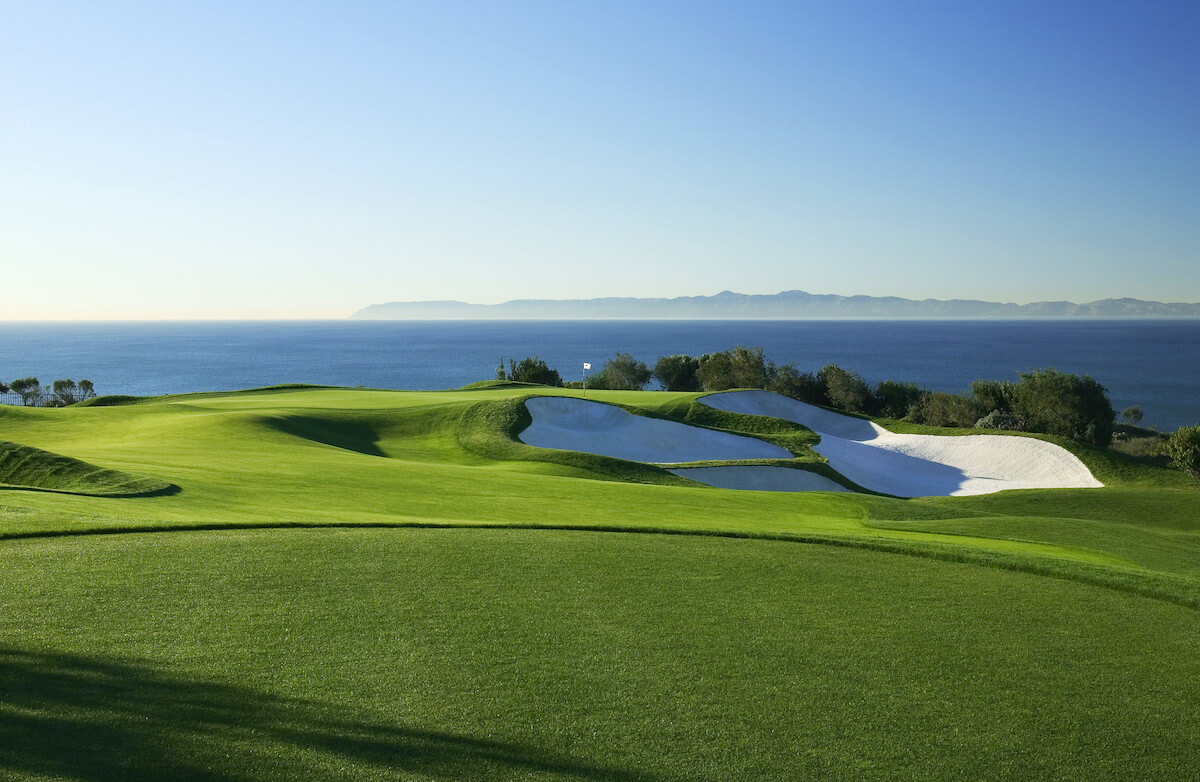
If you drive south from LAX, past the industrial hum of Long Beach and up into the steep, salt-sprayed cliffs of Rancho Palos Verdes, you’ll eventually hit a patch of grass so green it looks painted. This is Trump National Golf Club Los Angeles. It is a place that shouldn't exist. At least, not in its current form.
Most people know it for the name on the sign. But the real story of this patch of coastal real estate involves a catastrophic landslide, $264 million in costs, and a literal hole in the ground that swallowed $20 million all by itself.
Honestly, the "18th hole" drama is the stuff of local legend.
Back in 1999, when the course was still called Ocean Trails and owned by developer Edward Zuckerman, a massive chunk of the 18th fairway simply decided it didn't want to be a golf course anymore. It slid 50 feet toward the Pacific. One minute, Pete Dye—one of the most sadistic and brilliant architects in the game—was putting the finishing touches on a masterpiece. The next, 980 feet of fairway was floating in the ocean.
Trump bought the wreckage in 2002 for roughly $27 million. It was a bargain, relatively speaking. But the fix? That was the real gamble.
The $20 Million Fairway and the Pete Dye Legacy
You’ve got to appreciate the engineering here, even if you don't care about golf. To stop the 18th hole from sliding into the sea again, they had to move 1.25 million cubic yards of earth. They built what is essentially a massive underground fortress to keep the land still.
Because of that, the Trump National Golf Club Los Angeles became the most expensive golf course ever built at the time.
The layout is technically a "Signature Design" by Donald Trump and Tom Fazio, though it rests on the bones of Pete Dye’s original vision. Dye’s fingerprints are everywhere. You see it in the menacing bunkers and the way the course punishes a "safe" shot.
- The Yardage: 7,311 from the back tees.
- The Slope: 146 (which basically means "bring extra balls").
- The View: Every single hole has an ocean view.
That last point isn't marketing fluff. It’s actually true. Most coastal courses give you a glimpse of the water on the "signature" holes. Here, the Pacific is your constant, crashing companion. It’s beautiful. It’s also distracting when you're trying to ignore the 120-yard long bunker on the 12th hole.
Why Golfers Still Obsess Over "Trump's Corner"
If you're playing here, you need to prepare for holes 5 through 9. Local regulars call this "Trump's Corner." It's brutal.
The 5th hole is a par 4 that stretches 506 yards. Let that sink in. You need a 250-yard carry just to reach the short grass. Most amateur golfers don't have that in the bag. It’s a gut check. Then you hit the 7th, a 580-yard par 5 with a "spine" running through the fairway that kicks your ball into places you don't want it to go.
It’s kind of an arrogant course. It demands perfection and offers very little sympathy.
But it’s also public. That’s the weird part.
You’d think a place with a 45,000-square-foot clubhouse and gold-leafed locker rooms would be members-only. Nope. If you have the green fee (which can range from $160 to over $400 depending on the day and time), you can walk right on.
The Experience Beyond the Green
The clubhouse is honestly massive. 45,000 square feet of Mediterranean-style opulence. It feels more like a film set than a locker room—which makes sense, considering they filmed scenes from Step Brothers (the "Catalina Wine Mixer" was actually here) and Horrible Bosses 2 on the property.
If you aren't there to lose a dozen Titleists in the ice plant, people usually show up for the food.
- Cafe Pacific: High-end, white tablecloth stuff.
- The Golfer’s Lounge: More relaxed, better for a post-round burger.
- The Wine & Beer Festival: An annual event that actually draws a huge local crowd that couldn't care less about golf.
Practical Realities of Playing Here in 2026
Is it worth the money?
That depends on what you value. If you want a quiet, minimalist walk in the woods, this isn't it. This is "stadium golf." It’s loud, it’s dramatic, and it’s meant to be seen.
Booking a Tee Time: You can usually book up to 14 days out. If you're a single, you're basically at the mercy of the starter to slot you in with a group. They don't let singles book solo slots in advance.
The Dress Code: They are strict. No denim. Collared shirts. They’ll make you buy a $90 polo in the pro shop if you show up in a t-shirt. Don't be that person.
The Maintenance: Because of the geology of the Palos Verdes Peninsula, the course goes through heavy maintenance cycles. In 2025 and 2026, expect "Cart Path Only" rules during late autumn (usually November through mid-December) to protect the turf.
Actionable Tips for Your Visit
If you're planning a trip to Trump National Golf Club Los Angeles, do these three things to avoid the common pitfalls:
- Check the Wind: The afternoon winds off the Pacific turn a 400-yard hole into a 500-yard monster. If you aren't a scratch golfer, play a tee box further forward than you think you should. Your ego will hurt, but your score will thank you.
- Arrive Early for the Range: The practice facility is world-class. It’s one of the few places in LA where you’re hitting off real grass toward the ocean. Even if you don't play the course, you can pay for a large bag of balls ($30) and just soak in the view.
- Skip the Weekend if Possible: Monday through Thursday rates are significantly lower. You can often find "twilight" deals after 2:00 PM that get you on the course for under $150, which is a steal for this specific piece of land.
The landslide risk hasn't entirely disappeared—the whole peninsula is technically moving—but for now, the engineering is holding. It remains one of the most polarizing, expensive, and visually stunning 18 holes of golf in the United States. Whether you’re there for the history, the "Catalina Wine Mixer" vibes, or the challenge of Trump's Corner, it’s an experience that’s hard to replicate anywhere else on the West Coast.