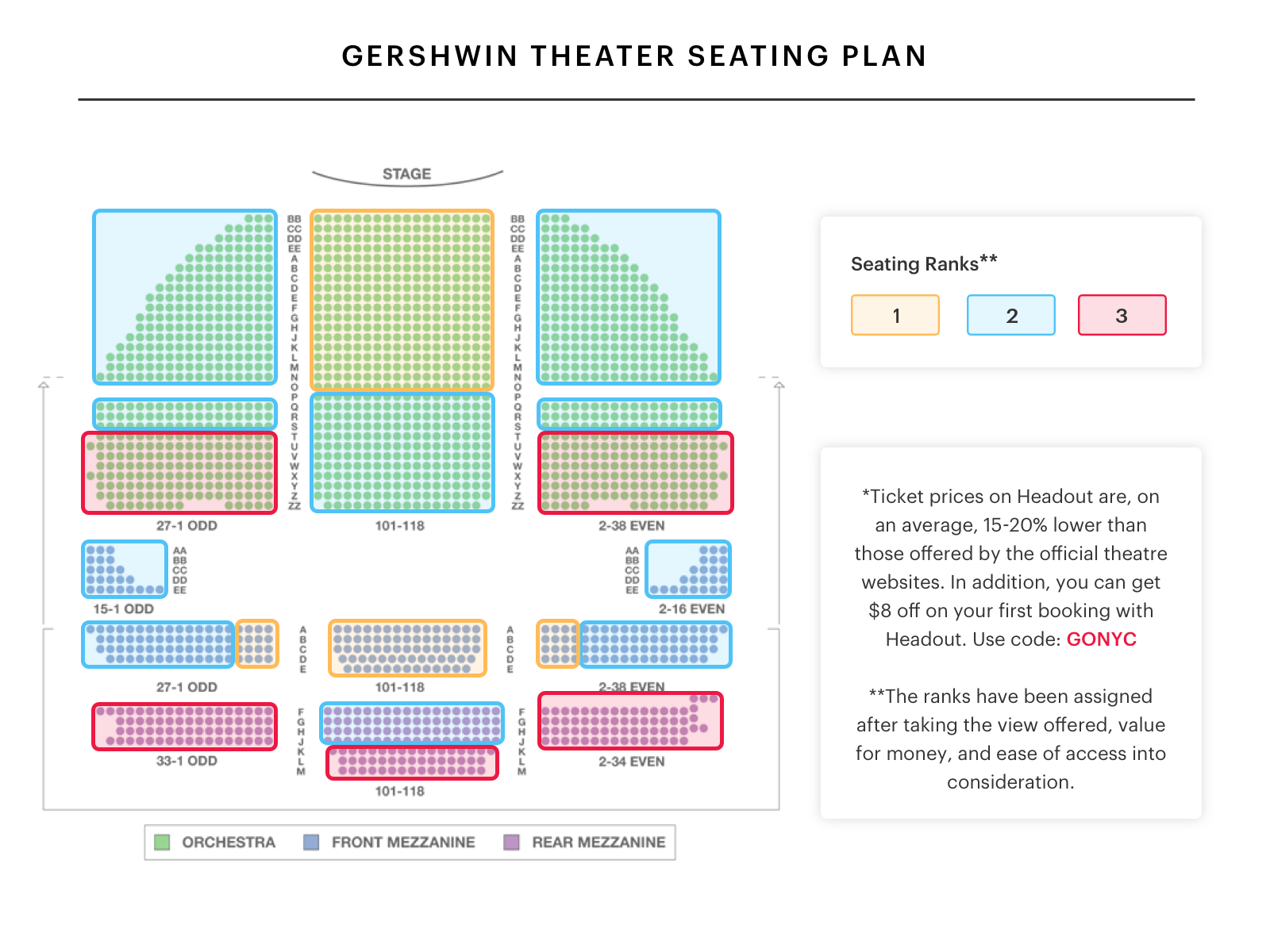
You're standing on 51st Street, looking up at that massive green marquee, and you realize something. The Gershwin is huge. Like, "largest theater on Broadway" huge. With 1,933 seats, picking the wrong spot is easier than you’d think. Honestly, I’ve seen people drop $300 on tickets only to realize they’re staring at the side of a mechanical dragon for two and a half hours.
Getting your Gershwin theater seating guide strategy right isn't just about spending the most money; it’s about understanding the unique "stadium-style" rake of this specific house. Unlike the cramped, 100-year-old theaters down the street, the Gershwin was built in 1972. It feels different. It breathes differently.
If you're there for Wicked—and let's be real, almost everyone is—the scale of the production matters. You want to see Elphaba fly, but you also want to see the emerald shimmer on the costumes. Those two things don't always happen from the same seat.
The Orchestra: Is Closer Actually Better?
Most people assume Row AA or A is the "gold standard." It's not.
In the Gershwin, the stage is quite high. If you sit in the first five rows of the Center Orchestra, you're going to be crane-necking it the whole time. You’ll see the sweat on the actors' brows, sure, but you’ll miss the choreography happening at the back of the stage. Plus, the "Bubble" entrance? You're basically looking straight up at Glinda’s shoes.
The "Sweet Spot" is generally considered to be Rows F through M.
In these rows, the elevation of the seating begins to work in your favor. You’re at eye level with the performers. The sound hits you perfectly because you’re right in the sweet spot of the house speakers. If you go too far back—say, past Row T—you start to feel the overhang of the Mezzanine. It doesn't cut off the stage, but it definitely changes the "vibe." It feels less immersive and more like you're watching a (very expensive) movie.
Don't ignore the Side Orchestra, but be careful. The Gershwin is wide. If you’re in a seat numbered higher than 20 on the far sides, you’re looking at the stage from a sharp angle. You might see into the wings, which some people think is cool, but it kind of ruins the "magic" of the stagecraft.
Why the Front Mezzanine Might Actually Be the Best Value
I’ll say it: The Front Mezzanine at the Gershwin is arguably better than the Orchestra.
Because the theater is designed with a steep rake, the Mezzanine feels much closer to the stage than it does in theaters like the Majestic or the St. James. Row A of the Mezzanine is legendary. You have an unobstructed view of the entire "Ozmopolitan" world.
When Elphaba hits that final note in "Defying Gravity," the lighting design covers the entire floor and the walls. From the Orchestra, you’re in it. From the Mezzanine, you see the art of it. It’s a trade-off.
Here’s a tip most people miss: The Mezzanine is divided into Front and Rear, but at the Gershwin, even the Rear Mezzanine isn't "bad." It’s high up—you’ll feel the altitude—but because the theater is so wide and the aisles are spaced well, you rarely have a "head in the way" problem.
The "Partial View" Trap
You’ll see tickets labeled "Partial View" or "Obstructed View" on sites like Ticketmaster or TodayTix.
In many Broadway houses, this means you’re sitting behind a literal pole. In the Gershwin, there are no poles. "Obstructed" here usually means you’re so far to the side that the massive "Proscenium" (the arch around the stage) blocks the back-left or back-right corner of the set.
For Wicked, this is a big deal.
A lot of the action happens on the upper levels of the clockwork set. If you're in a far-right partial view seat, you might miss the "Wizard" in his giant mechanical head. Is it worth the $80 savings? Maybe, if you’ve seen the show before. If it’s your first time, skip the partial view. You’ll regret not seeing the full scale of the production.
Accessibility and Comfort: The 1970s Perk
One thing the Gershwin theater seating guide must highlight is comfort. Most Broadway theaters were built for people in 1910. The seats are tiny. The legroom is non-existent.
The Gershwin is different.
The seats are wider. There is actual legroom. If you are a taller human, you won't leave with your knees bruised. Also, the theater is fully accessible with an elevator—a rarity in New York theater. There are designated wheelchair locations in the back of the Orchestra that offer surprisingly great views because the floor is sloped.
The Sound Science of the Room
Acoustically, the Gershwin is a beast. It’s a massive space to fill with sound.
If you sit way out on the sides, the sound can sometimes feel a bit "thin." The center sections—both Orchestra and Mezzanine—benefit from the way the sound bounces off the back wall. If you’re a total audiophile, aim for the Center Orchestra, Row P. It’s far enough back that the sound from the pit and the speakers has time to mix perfectly.
Practical Advice for Your Visit
Don't just show up and hope for the best.
- Check the Map Twice: Look at the official Gershwin seating chart. The "even" numbers are on the right, and "odd" numbers are on the left. If you see Seat 1 and Seat 2, they aren't next to each other. They are across the aisle from each other.
- The Bathroom Situation: It’s a nightmare. Even though the Gershwin is modern, the lines for the ladies' room at intermission are legendary. If you’re in the Mezzanine, try to be the first one out the door when the lights come up for Act 1.
- The Dragon Factor: The giant mechanical dragon sits above the stage. If you sit too far forward in the Orchestra, you actually have to look backward and up to see it move.
- Binoculars: If you're in the Rear Mezzanine (Rows F-M), bring them. The facial expressions in "For Good" are what make the show emotional, and you’ll miss the tears from that distance without a little help.
How to Get the Best Seats Without Going Broke
The "Premium" seats are the middle of the Orchestra, rows C through M. They will always be the most expensive.
If you want a "pro move," look for seats in the Mid-Mezzanine. Often, the price drops significantly between the Front Mezzanine and the Mid-Mezzanine, but the view only changes by about 10 feet.
Also, consider the "In-Person Lottery." It’s rare now that everything has moved to digital, but checking the box office at 10:00 AM for "cancellation seats" can sometimes land you a Front Orchestra seat for a fraction of the price.
Final Verdict on Where to Sit
If money is no object: Center Orchestra, Row G. It’s the perfect distance.
If you want the best "show" experience: Front Mezzanine, Row A, Seats 101-114. If you’re on a budget: Rear Mezzanine, Center. Avoid the far sides of the Rear Mezzanine unless you really don't mind missing the edges of the stage.
The Gershwin is a grand, sweeping space. It was built for spectacle. Whether you’re in the "cheap seats" or the front row, the "Defying Gravity" sequence is designed to fill that entire room. Just avoid the very far edges of the Orchestra, and you’ll have a fantastic time.
Now, your next step is to head over to the official Broadway Direct site or the Gershwin box office and look for those Center Mezzanine "Sweet Spot" seats before they're snatched up by the weekend crowds. Check the specific seat numbers against a virtual view tool to ensure you aren't stuck behind a taller patron, though the Gershwin's floor slope usually makes that a non-issue compared to other theaters.