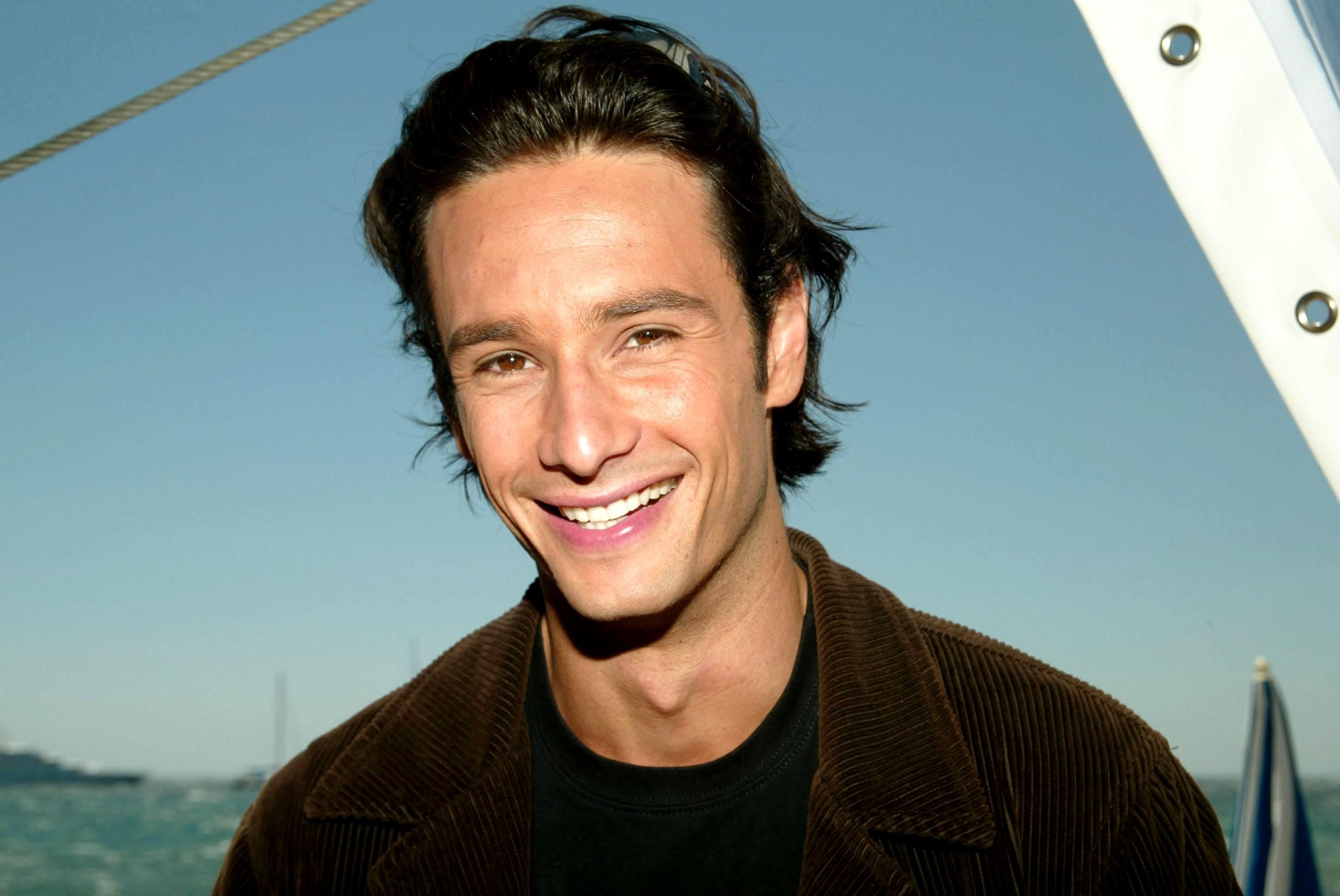
You probably remember the early 2000s for its low-rise jeans, neon-soaked music videos, and the high-octane, slightly chaotic energy of McG’s filmmaking. At the center of that whirlwind was Charlie’s Angels: Full Throttle, a sequel that pushed the "more is more" philosophy to its absolute limit. But if you look past the Motocross jumps and the Demi Moore villain arc, there’s one specific casting choice that actually changed the trajectory of international actors in Hollywood.
Enter Rodrigo Santoro.
Before he was the god-king Xerxes in 300 or the brooding outlaw Hector Escaton in Westworld, Santoro was Randy Emmers. Honestly, the role was simple: he was the "surfer assassin." He didn't have many lines. In fact, he barely spoke. But he didn't need to. His presence in that movie was a massive deal for the Brazilian film industry and served as a weird, silent bridge between Latin American cinema and the global blockbuster machine.
Who Was Randy Emmers Anyway?
In the logic-defying world of Full Throttle, Santoro's Randy Emmers is a lethal henchman hired by Madison Lee (Demi Moore). He first pops up during the iconic Zuma Beach scene. You know the one—Cameron Diaz, Drew Barrymore, and Lucy Liu are undercover, things are bright, and suddenly there’s this incredibly fit guy with a surfboard who looks like he walked out of a high-end fragrance ad.
He wasn't just eye candy, though. Randy was part of the movie’s heightened, comic-book reality. He was a silent threat. While most actors would struggle to make an impact with zero dialogue, Santoro used his physicality to sell the character. It was a role that relied entirely on "the look" and the vibe. For American audiences in 2003, he was a fresh face. For Brazilians, he was already a superstar, and seeing him on screen with Cameron Diaz was a "we made it" moment.
Interestingly, Santoro didn't even have an agent in North America when he landed the gig. He’d just finished a TV production called The Roman Spring of Mrs. Stone with Helen Mirren. The story goes that a producer saw him at a premiere for Behind the Sun (a heavy, critically acclaimed Brazilian drama) and essentially thought, "That guy needs to be our assassin."
The "Silent" Hollywood Debut
It’s kinda funny to look back and realize that one of Brazil’s most respected dramatic actors made his big Hollywood splash without saying a word. In Brazil, Santoro had already won multiple Best Actor awards for Bicho de Sete Cabeças (Brainstorm), a harrowing film about mental health and institutionalization.
Transitioning from that level of "serious" acting to being a silent surfer in a McG movie is a wild pivot.
Some critics at the time felt the role was a waste of his talent. Why take a guy who can deliver a Shakespearean monologue and turn him into a human prop? But if you talk to industry insiders, they’ll tell you it was a brilliant strategic move.
- Visibility: Full Throttle was a global monster. It put his face in front of every casting director in Los Angeles.
- The "Mystery" Factor: By not speaking, he maintained an air of international mystery that led directly to his casting in Love Actually as Karl, the enigmatic designer.
- Breaking the Mold: He didn't play a stereotypical drug dealer or a generic "foreign" criminal. He was a cool, dangerous surfer.
Why This Role Was a Turning Point for Santoro
Most people don't realize that Charlie's Angels: Full Throttle was the catalyst for everything that followed. Shortly after the movie hit theaters, the "Santoro fever" began.
He didn't just stay in the "pretty boy" lane. He used the momentum from the Angels franchise to secure a meeting for 300. When Zack Snyder saw him, he didn't see the surfer; he saw the potential for the 9-foot-tall, gold-covered Xerxes. That’s a range most actors can’t pull off.
We also have to talk about Lost. His character, Paulo, is famously polarizing among fans (some hated the "mid-season addition" of Nikki and Paulo), but again, it was a major network role for a South American actor at a time when those were rare.
The Impact on Global Casting
Looking at the landscape of 2026, we see actors like Wagner Moura, Pedro Pascal, and Alice Braga everywhere. But in 2003, the door was only halfway open. Santoro's stint as Randy Emmers proved that you could take a "foreign" lead and slot them into a massive American franchise without it feeling forced or like a caricature.
He showed that "international appeal" wasn't just a buzzword; it was a box office reality. Full Throttle might be a loud, messy movie, but it was also a laboratory for the kind of globalized casting we take for granted today.
What to Watch if You Liked Him in Charlie's Angels
If you're revisiting his filmography, don't stop at the surfer assassin. Here is how you should actually track his career progression:
- Bicho de Sete Cabeças (2001): To see the raw talent that got him noticed.
- Love Actually (2003): The role that made everyone fall in love with him (and feel bad for Laura Linney).
- 300 (2006): Total physical and vocal transformation.
- Westworld (2016-2022): His most nuanced work in English, playing with the "outlaw" trope he started in Charlie's Angels.
Practical Next Steps for Film Fans
If you're curious about how Santoro's career influenced current Hollywood trends, start by looking at the production credits of recent international co-productions. You'll notice a pattern: the "Santoro Route." It involves a high-profile, often silent or physical role in a blockbuster to establish a "face," followed by a sharp pivot into prestige television or character-driven indies.
Keep an eye on his recent Brazilian projects like Good Morning, Verônica on Netflix. He’s moved back toward the intense, darker roles of his youth, but with the polished experience of twenty years in the Hollywood system. It’s a full-circle moment that wouldn't have happened without a surfboard and a neon-lit beach in 2003.