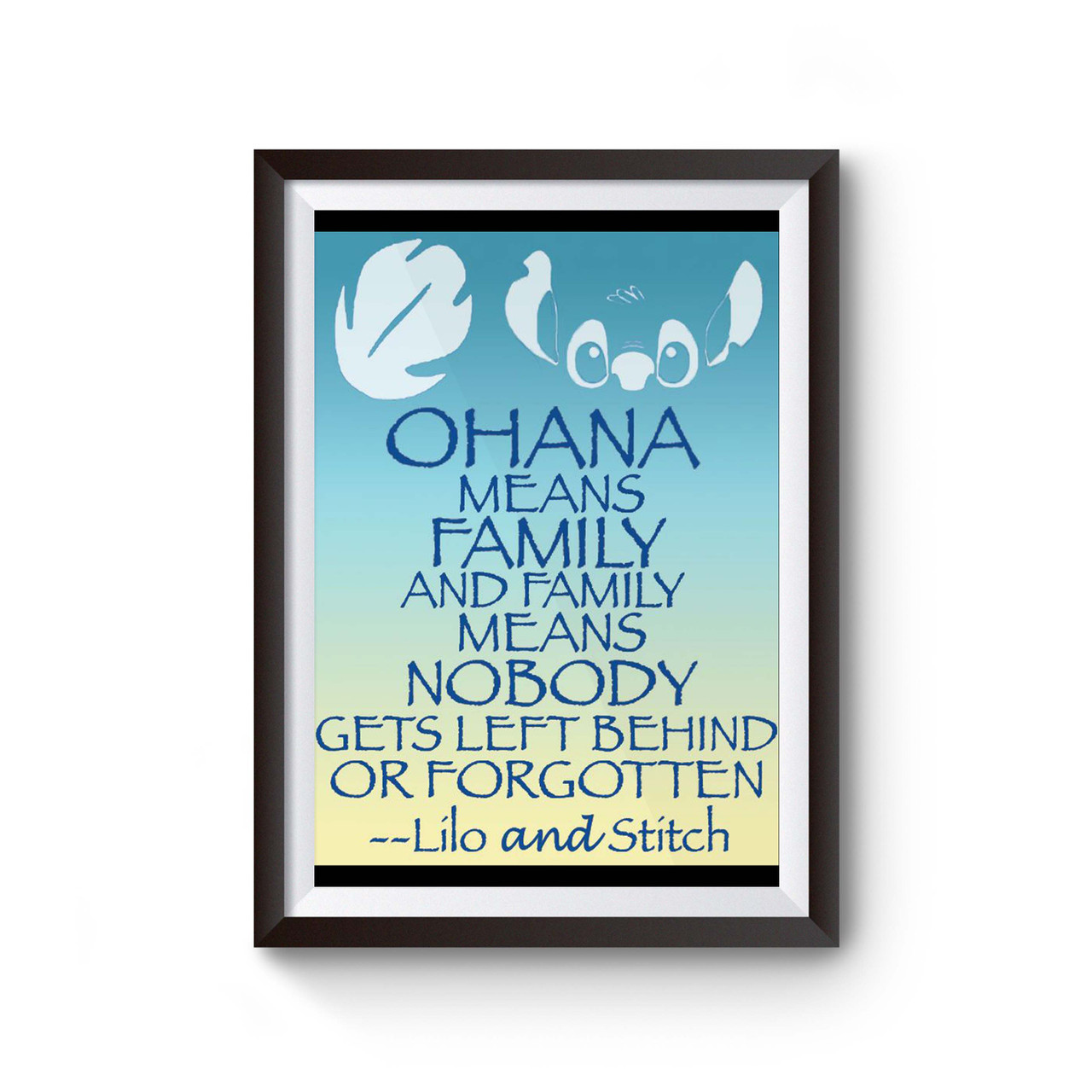
Everyone knows the line. You’ve seen it on mugs, t-shirts, and probably tattooed on at least three people you follow on Instagram. Ohana means family. It's the emotional heartbeat of Disney's 2002 hit Lilo & Stitch. But if you think it’s just a cute catchphrase used to sell plush toys, you’re missing the actual weight of the movie.
Honestly? Most people get it wrong.
They think "Ohana" is just a Hawaiian word for a nuclear family. It isn't. In the context of the film, and in real Hawaiian culture, it’s much heavier than that. It’s about accountability. It’s about the fact that no one gets left behind or forgotten, even when they’re acting like a literal monster from outer space.
When Lilo Pelekai says those words to her sister Nani, or later to the chaotic blue Experiment 626, she isn't just being sweet. She's desperate. She is a grieving child clinging to the only concept that keeps her world from falling apart after her parents' death.
The Actual Origin of the Ohana Philosophy
Let’s talk about where this actually came from. Disney didn't just pull this out of a hat. During the production of the film, the creators—Dean DeBlois and Chris Sanders—took a research trip to Kauai. They were struck by how the locals lived. They noticed that "family" wasn't restricted to blood relatives. It extended to the entire community.
A local tour guide reportedly explained the concept of "Ohana" to them, and it clicked. It became the glue for the entire script.
In the film, the full quote is: "Ohana means family. Family means nobody gets left behind or forgotten." It's a simple mantra. But look at the stakes. Nani is a nineteen-year-old trying to hold down a job while a social worker, Cobra Bubbles, threatens to take her sister away. Lilo is a "weird" kid who doesn't fit in with her hula class. Stitch is a genetic experiment designed for destruction.
They are all broken.
The brilliance of the movie is that it doesn't fix their problems with magic. It fixes them with presence. Ohana isn't a solution; it’s a commitment to stay in the room when things get ugly.
Why Lilo & Stitch Was Radical for Disney
Most Disney movies before 2002 were about princesses or talking animals in distant kingdoms. Lilo & Stitch was different. It was messy. It showed a house with unwashed dishes. It showed a sister screaming at her sibling because she was stressed out.
It felt real.
The Found Family Trope
We see this everywhere now. Guardians of the Galaxy, Fast & Furious, The Avengers. The "Found Family" trope is a staple of modern storytelling. But Lilo & Stitch did it with a raw, grounded energy that most blockbusters lack.
Stitch doesn't become "good" because he wants to be a hero. He becomes good because he finally has a place where he isn't a "glitch." He’s a part of an Ohana.
Interestingly, the original ending of the movie had to be changed. Originally, Stitch hijacked a commercial 747 jet to save Lilo. Because the movie was being finished around September 11, 2001, the filmmakers had to scramble. They swapped the plane for a spaceship and moved the chase to the mountains of Kauai. Even with those massive production hurdles, the core message—that Ohana means family—never wavered. The stakes were always about keeping the unit together.
Beyond the Quote: The Real Meaning of "Ohana"
In traditional Hawaiian culture, ’ohana comes from the word ’ohā, which refers to the root or corm of the kalo (taro) plant. Kalo is the staple of the Hawaiian diet and is considered a sacred ancestor of the Hawaiian people.
When you think about it that way, the metaphor gets deeper.
- The Root: Everything comes from the same source.
- The Offshoots: New growth stays connected to the original root.
- The Sustenance: You cannot survive without the support of the plant.
So, when the movie uses this word, it’s invoking a lineage that spans generations. It’s not just about who lives in your house. It’s about your ancestors and your future. It’s about the responsibility you have to the people who came before you and those who will follow.
Common Misconceptions About the Film
I see people online all the time saying that Stitch is the main character.
He’s not.
Lilo is.
Stitch is the catalyst, sure. But the emotional arc belongs to Lilo and Nani. The movie is actually a tragedy disguised as a sci-fi comedy. Think about it. Two sisters are drowning in grief while the government tries to separate them.
The quote "Ohana means family" is Lilo’s shield. She uses it to justify keeping a destructive alien because she can't handle losing one more thing.
Does it mean you have to forgive everyone?
Some critics argue that the "nobody gets left behind" logic can be toxic. Does it mean you have to stay with people who hurt you?
In the film, the answer is nuanced. Stitch has to change. He has to stop destroying things. He has to learn to build. Ohana isn't a free pass to be a jerk; it’s an invitation to be better because people love you. It’s a reciprocal agreement.
The Legacy of the Quote in Pop Culture
Why is this still trending decades later?
Because we live in an era of isolation. People are lonelier than ever. The idea that there is a group of people—blood or chosen—who will refuse to forget you is incredibly powerful.
- The Merchandise: You can't walk into a Hot Topic or a Disney Store without seeing it.
- The Live-Action Remake: With a live-action version in the works, the conversation around the Hawaiian setting and the "Ohana" philosophy is resurfacing.
- Social Media: It’s a shorthand for "this is my squad."
But let's be real. If you’re going to use the quote, you should probably respect the culture it comes from. Hawaii has a complex history with tourism and the commercialization of its language. Using "Ohana" as a marketing gimmick is one thing; living it out by showing up for your friends when they’re at their absolute worst is another.
How to Apply "Ohana" to Your Own Life
You don't need a blue alien to have an Ohana.
It starts with the people who are already there. It's the friend who answers the phone at 3:00 AM. It's the cousin who always invites you over even when you haven't called in months.
Actionable Steps for Building Your Ohana:
- Define your "Found Family": Identify the 3-5 people who aren't related to you but who feel like home. Tell them.
- Show up when it’s inconvenient: "Nobody gets left behind" is easy when things are going well. It’s hard when someone is going through a divorce, a job loss, or a mental health crisis. That's when the Ohana kicks in.
- Acknowledge the "Glitches": We all have "glitches" like Stitch. An Ohana allows for mistakes while holding the person accountable to grow.
- Respect the Roots: If you’re interested in the culture behind the word, look into Hawaiian history and the significance of the kalo plant.
Final Thoughts on the Pelekai Legacy
The beauty of Lilo & Stitch is that it ends with a photo album.
The characters are still messy. Their house is still a bit of a wreck. But they are together. Ving Rhames (who voiced Cobra Bubbles) delivered the line perfectly: "They're a good family. Resilient."
That’s what "Ohana means family" is really about. It’s not about being perfect. It’s about being resilient. It’s about the fact that even if you were "created" to destroy, you can choose to belong.
If you want to dive deeper into the themes of the film, watch the "making of" documentaries. They show just how much the animators cared about capturing the specific light and feel of Hawaii. They didn't want a postcard; they wanted a home. And that’s exactly what they gave us.
Next Steps for Fans:
- Re-watch the original 2002 film with an eye on Nani’s struggles—it changes the whole experience.
- Support authentic Hawaiian creators and artists who explore the concept of ‘ohana in modern contexts.
- Evaluate your own "Stitch" moments: who are the people who didn't leave you behind when you were difficult to love? Reach out to them today.