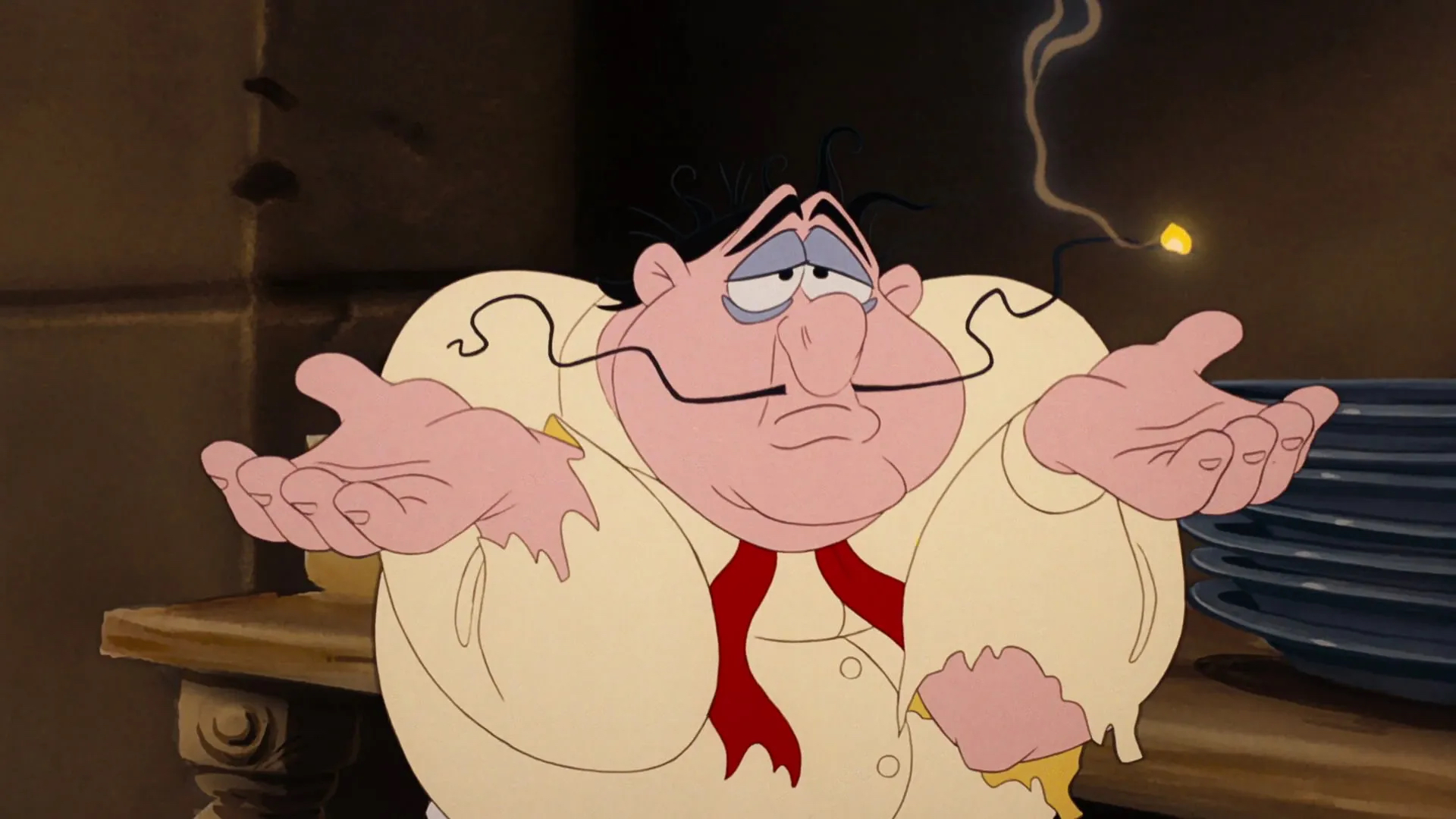
He is barely on screen for five minutes. Seriously. If you go back and time it, the French cook in Disney's 1989 classic The Little Mermaid has less screen time than some of the background fish in "Under the Sea." Yet, Chef Louis remains one of the most vivid, chaotic, and oddly terrifying memories for anyone who grew up during the Disney Renaissance.
He’s not a villain. At least, not in the traditional sense. Ursula wants the throne; Louis just wants to serve a decent lunch. But for a generation of kids, that high-pitched "Les Poissons" song was their first introduction to the brutal reality of the food chain.
The Chef the Little Mermaid Fans Love to Hate
Honestly, the tonal shift when Ariel enters Prince Eric’s castle is jarring. We go from a sweeping, romantic underwater epic to what is essentially a Looney Tunes short. Chef Louis enters the frame with a massive mustache and an even bigger cleaver, and suddenly, the movie isn't about a girl finding her voice. It's about a crab trying not to get stuffed with breadcrumbs.
Why does this character stick?
It’s the energy. René Auberjonois, the late actor who voiced Louis, reportedly channeled a mix of manic French stereotypes and pure theatrical camp. He wasn't just playing a cook; he was playing a man possessed by the culinary arts. When you watch him dismember a fish while singing about pulling out their gizzards, it’s remarkably dark for a G-rated movie.
Behind the Animation: Meat Cleavers and Slapstick
The animation in the Chef Louis sequence was handled primarily by Glen Keane’s team, though the comedic timing feels like a throwback to the rubber-hose era of the 1930s.
Look at the physics. When Louis chases Sebastian the crab around the kitchen, the environment becomes a weapon. Boiling pots, rolling pins, and silver platters turn into a chaotic obstacle course. It’s a masterclass in squash-and-stretch animation. The way Louis’s face contorts when he realizes a crab is pinching his nose is pure gold. It’s a break from the "Disney Princess" aesthetic that gives the film its necessary grit.
Most people don't realize how much that scene anchors the movie's stakes. Up until that point, Sebastian is a nag. He’s the "stick-in-the-mud" advisor. But the moment he’s on the chopping block in Louis’s kitchen, he becomes an underdog we actually care about.
Why Les Poissons Is the Darkest Song in the Movie
"Poor Unfortunate Souls" is the villain anthem, sure. It’s spooky. But "Les Poissons" is about industrial-scale slaughter, and it's played for laughs.
- The Lyrics: Louis sings about hacking off heads and "zapping" fish with salt.
- The Visuals: He literally stuffs a smaller fish inside a larger fish. It’s the "Turducken" of 1989 animation.
- The Psychological Impact: For kids, seeing the sentient friends of Ariel being prepared as a four-course meal is a bit of a reality check.
The song works because it’s a waltz. It’s bouncy. It’s catchy. You find yourself humming it while watching a man try to commit "crustacean-cide." That’s the genius of Howard Ashman and Alan Menken. They knew that to make the kitchen scene work, it had to feel like a celebration of the macabre.
The Chef Louis Legacy in Live Action and Beyond
When Disney announced the 2023 live-action remake, fans were curious: how do you do the Chef Louis scene without it looking like a PETA nightmare?
Interestingly, the live-action version took a different route. In the 2023 film, the role of the chef (played by Art Malik as Sir Grimsby’s staff) is significantly dialed back. The slapstick is gone. Some fans hated this. They felt the "heart" of the castle’s chaos was missing. Others argued that a hyper-realistic man trying to murder a hyper-realistic crab would be too traumatizing for modern seven-year-olds.
But it proves a point. You can't replicate that 1989 energy.
The Culinary Reality: What Was He Actually Making?
If you look closely at the "Chef the Little Mermaid" scene, Louis isn't just throwing things in a pot. He's actually performing specific French techniques.
- Farci: He talks about stuffing the fish with breadcrumbs.
- Meunière: There’s a lot of butter and flour flying around.
- Bouillabaisse: He’s essentially aiming for a high-end seafood stew.
He’s a professional. A maniac, but a professional. If he weren't trying to kill our favorite sidekick, we’d probably be impressed by his knife skills. The "Chef Louis" character represents the era’s obsession with high-brow French cuisine being the pinnacle of luxury—something that Eric’s kingdom clearly aspires to.
Why We Need Characters Like Louis
Modern movies often try to make every character "deep." They need a tragic backstory. They need a reason for being the way they are.
Louis doesn't have that. He loves fish. He loves cooking. He has a short fuse. That’s it.
He serves as a "bottleneck" character. He’s there to provide a specific obstacle, a bit of comic relief, and a reminder that the world outside the ocean is a dangerous place for a creature with a shell. Without the Chef Louis sequence, the middle of the movie would drag. It’s the shot of adrenaline that carries us through the transition of Ariel becoming human.
The Slapstick Philosophy
Comedy in animation is often overlooked in favor of the "big" emotional beats. But the kitchen fight is a rhythmic masterpiece. Every time Louis swings his cleaver, it’s on a beat. Every time Sebastian hides under a lettuce leaf, the silence is timed perfectly.
It’s a reminder that Disney used to be unafraid of being "ugly." Louis isn't a handsome prince. He’s a sweaty, disheveled man with a stained apron. That realism—well, cartoon realism—adds a layer of texture to the film that makes the magical elements pop even more.
Actionable Takeaways for Fans and Collectors
If you're a fan of this specific niche of Disney history, there are a few things you should actually do to appreciate the character more.
Watch the "Making of" Documentaries
The Diamond Edition Blu-ray has segments on the voice acting. Watching René Auberjonois record "Les Poissons" is a revelation. He’s literally jumping around the studio. It explains why the character feels so high-energy; the actor was giving a workout to the microphone.
Look for the Hidden Details
In the kitchen scene, look at the background art. The copper pots, the hanging herbs—it's some of the most detailed background work in the whole movie. The artists clearly spent a lot of time researching 18th-century European kitchens.
Re-evaluate the "Villain" Status
Louis is often included in "Disney Villain" merchandise despite not being the antagonist. He’s more of an "environmental hazard." If you're a collector, his pins and Funko Pops (yes, they exist) are usually part of the "Villains" sets, which is a hilarious misunderstanding of his actual job description.
The Kitchen Lesson
If you’re a cook, don't follow Louis’s advice. You don't need to chase your food around the room. And you definitely don't need to sing about it. But do take a page from his book regarding passion—the man clearly cares about the final product, even if he has to burn the whole kitchen down to get it.
The Chef Louis scene remains a pillar of 80s animation because it’s unapologetic. It’s loud, it’s violent, and it’s hilarious. In an era where everything is sanitized, re-watching a frantic Frenchman chase a crab with a meat cleaver is a refreshing reminder of when Disney was a little bit weird.
For those looking to dive deeper into the animation of this era, comparing the 1989 kitchen scene with the "Be Our Guest" sequence in Beauty and the Beast shows how Disney evolved their "food choreography" in just two years. While Louis was about chaos, Beauty and the Beast was about order. Both are iconic, but only one features a man getting pinched on the nose by a Jamaican crab.
To truly understand the impact of the chef in The Little Mermaid, you have to look past the mustache. He is the bridge between the whimsical underwater world and the harsh, practical world of humans. He’s the guy who reminds us that for Ariel to live in Eric’s world, she has to navigate a place where her friends are literally on the menu.